Weltweiter Gratisversand – 30 Tage risikofrei testen

What is a watch dial? A 2026 guide for Seiko mods

The watch dial is often called the soul of a timepiece, yet many enthusiasts underestimate its complexity. Far from being a simple decorative element, the dial represents the intersection of engineering precision and artistic expression. It’s the primary interface between you and the movement’s mechanics, translating intricate gear rotations into readable time. For Seiko mod enthusiasts, understanding dial anatomy, materials, and finishes unlocks endless customization possibilities. This guide explores everything from basic dial construction to advanced finishing techniques, helping you make informed decisions when building or modifying your next Seiko watch.
Table of Contents
- Understanding The Anatomy And Role Of A Watch Dial
- Materials, Manufacturing, And Craftsmanship Behind Watch Dials
- Dial Finishes And Styles: Balancing Aesthetics And Legibility
- Customizing Watch Dials: Options And Considerations For Seiko Mods
- Explore Unique Seiko Watch Customizations At Ottoman Prieur
- Frequently Asked Questions About Watch Dials And Seiko Customization
Key takeaways
| Point | Details |
|---|---|
| Dial function | The dial serves as the visible time-displaying interface between wearer and movement mechanics. |
| Material construction | Most dials use brass or aluminum base plates with layered finishes, markers, and luminous material. |
| Finish variety | Sunray, matte, and glossy finishes each offer distinct visual effects and legibility characteristics. |
| Customization potential | Seiko mod dials allow personalized expression through finish, color, marker style, and lume choices. |
| Quality considerations | Manufacturing complexity ranges from simple printed dials to artisanal pieces requiring 200+ operations. |
Understanding the anatomy and role of a watch dial
A watch dial is the visible face of the watch that displays time via hour markers, numerals, indices, and hands, serving as the primary interface between the wearer and the movement’s mechanics, blending aesthetics, legibility, and functionality. This seemingly simple component actually comprises multiple integrated elements working together.
The main dial components include hour markers, which can be printed numerals, applied indices, or a combination of both. The minute track typically circles the dial’s perimeter, providing precise time reading. Hands sweep across these markers, driven by the movement beneath. Some dials incorporate additional elements like date windows, subdials for chronograph functions, or power reserve indicators.
Dial design directly impacts legibility. High contrast between dial color and hand color ensures quick time reading. Marker size and style affect readability at various distances and lighting conditions. The dial’s relationship with the movement is crucial because it must accommodate the hand stack, date mechanism, and any complications without interference.
Common layout conventions have evolved over decades. The 12-3-6-9 configuration uses larger markers at cardinal positions. Some designs employ all numerals, while minimalist dials feature only index markers. Sports watches often prioritize bold markers and high luminosity, while dress watches favor subtle elegance.
Pro Tip: When evaluating dial quality, examine marker alignment and printing sharpness under magnification. Even slight misalignment reveals manufacturing shortcuts that affect overall watch value.
For those interested in Seiko watch customization, understanding these fundamentals helps you appreciate how dial choices influence the final aesthetic. The dial sets the watch’s character, whether you’re building a vintage-inspired piece or a modern sports watch.
Key dial elements to recognize:
- Hour markers provide primary time reference points
- Minute track enables precise time reading to the second
- Hands translate movement rotation into visual time display
- Luminous material ensures visibility in low light conditions
- Surface finish creates depth and visual interest
Materials, manufacturing, and craftsmanship behind watch dials
Watch dials are typically constructed from a base plate of brass, aluminum, or other metals, affixed to the movement via feet or screws, with layers of finishes, markers, and lume applied for durability and readability. The material choice impacts weight, durability, and finishing possibilities.
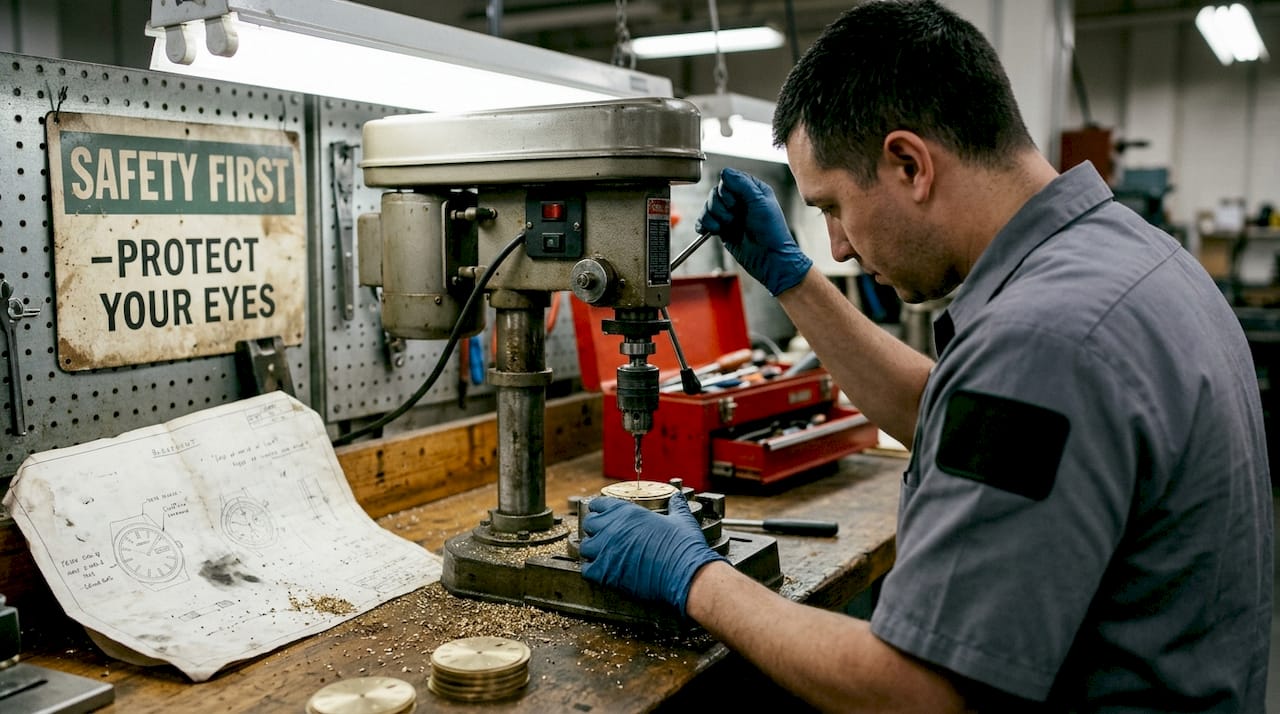
Brass remains the most common base material due to its workability and stability. Aluminum offers lighter weight for larger dials. Some manufacturers use copper or specialized alloys for specific aesthetic effects. The base plate thickness typically ranges from 0.3mm to 0.8mm, balancing structural integrity with overall watch thickness.
Dial attachment methods vary by movement design. Dial feet are small posts soldered to the dial’s reverse side that fit into corresponding holes in the movement plate. This method allows precise positioning and easy removal. Some movements use screw attachments, offering stronger mounting but requiring careful alignment during assembly.
The manufacturing process involves multiple stages:
- Base plate stamping or cutting to precise dimensions
- Surface preparation through cleaning and deburring
- Finish application using specialized techniques
- Marker placement through printing or applied methods
- Luminous material application to markers and hands
- Protective coating to prevent oxidation and damage
- Quality inspection for alignment and finish consistency
- Final assembly preparation including dial feet attachment
High-end dial production can involve 50 to 200 individual operations spanning several months. Artisanal techniques like hand guilloché engraving or grand feu enamel firing require master craftspeople with years of specialized training. Even mid-range dials demand precision machinery and skilled operators to achieve consistent quality.
| Manufacturing Method | Typical Operations | Production Time | Cost Impact | | — | — | — | | Basic printed dial | 15 to 30 | 1 to 3 days | Low | | Applied marker dial | 40 to 70 | 1 to 2 weeks | Medium | | Textured finish dial | 50 to 90 | 2 to 3 weeks | Medium-High | | Artisanal specialty | 100 to 200+ | 1 to 6 months | Very High |
Pro Tip: When sourcing custom Seiko mod dials, verify the base material and attachment method compatibility with your movement. Mismatched dial feet positions will prevent proper installation and potentially damage the movement.
The craftsmanship quality directly affects long-term durability. Poor finish adhesion leads to flaking or discoloration. Improperly applied lume can crack or lose luminosity. Quality control during manufacturing separates professional-grade dials from budget alternatives, making this knowledge essential for serious modders.
Dial finishes and styles: balancing aesthetics and legibility
Finishes like sunray, matte/grainé, and glossy lacquer/enamel affect legibility and aesthetics; printed markers are economical, applied markers add luxury depth. Each finish type creates distinct visual effects and practical performance characteristics.
Sunray finishes use radial brushing from the dial center outward, creating dynamic light reflection that changes with wrist movement. This finish adds perceived depth and visual interest without compromising legibility. Matte or grainé finishes provide non-reflective surfaces ideal for high-glare environments, popular in military and tool watches. Glossy lacquer or enamel finishes deliver rich color saturation and mirror-like surfaces that enhance formal aesthetics.
Dial finishing balances light interaction for depth and legibility, with glossy finishes providing contrast while textured finishes reduce glare; contrasting views see printed dials as practical versus hand-engraved as artisanal superiority. This balance becomes critical when selecting finishes for specific use cases.
Marker types significantly impact perceived quality and functionality. Printed markers lie flat on the dial surface, created through pad printing or screen printing techniques. They offer design flexibility and cost efficiency but lack dimensional depth. Applied markers are separate metal pieces affixed to the dial, creating shadows and three-dimensional presence. They catch light differently than the dial surface, improving legibility and adding luxury appeal.
| Finish Type | Visual Effect | Legibility | Durability | Best Use Case |
|---|---|---|---|---|
| Sunray | Dynamic radial reflection | Good | Excellent | Dress and sport watches |
| Matte/Grainé | Non-reflective texture | Excellent | Very Good | Tool and military watches |
| Glossy Lacquer | Mirror-like depth | Good | Good | Formal dress watches |
| Guilloché | Hand-engraved patterns | Good | Excellent | Luxury timepieces |
Artisanal finishes represent the pinnacle of dial craftsmanship. Guilloché involves hand-engraving intricate geometric patterns using a rose engine lathe, creating mesmerizing textures that play with light. Grand feu enamel requires firing mineral powder at extreme temperatures, producing luminous color depth unmatched by modern techniques. Meteorite dials use actual sliced meteorite, showcasing unique Widmanstätten patterns formed over millions of years in space. Stone dials incorporate materials like lapis lazuli or aventurine for striking visual effects.
These specialty finishes carry inherent risks. Enamel can crack from impact or thermal stress. Guilloché patterns reveal even minor imperfections in execution. Vintage dials develop patina or fading that some collectors prize while others avoid. Understanding these trade-offs helps you make informed customization choices.
Common dial finish considerations:
- Light reflection patterns affect readability in various conditions
- Texture depth influences perceived quality and value
- Color stability varies significantly between finish types
- Maintenance requirements differ based on finish durability
- Personal aesthetic preferences should align with practical needs
The dial finish you choose defines your watch’s character more than any other single element. A sunray blue dial evokes ocean depths, while matte black signals tactical purpose. Your finish selection communicates your style and priorities to fellow enthusiasts.
For custom versus factory watches, finish selection offers one of the most impactful personalization opportunities. Factory options typically limit you to a handful of colorways, while custom builds open the full spectrum of finishes and effects.
Customizing watch dials: options and considerations for Seiko mods
Customizing Seiko watch dials requires understanding both aesthetic possibilities and technical constraints. The dial serves as your watch’s signature element, making informed choices essential for achieving your vision while maintaining functionality.
Key custom dial elements include finish type, color selection, marker style, and luminous material. Dial finishing balances light interaction for depth and legibility, with glossy finishes providing contrast while textured finishes reduce glare. Your finish choice should align with intended use and personal style preferences.
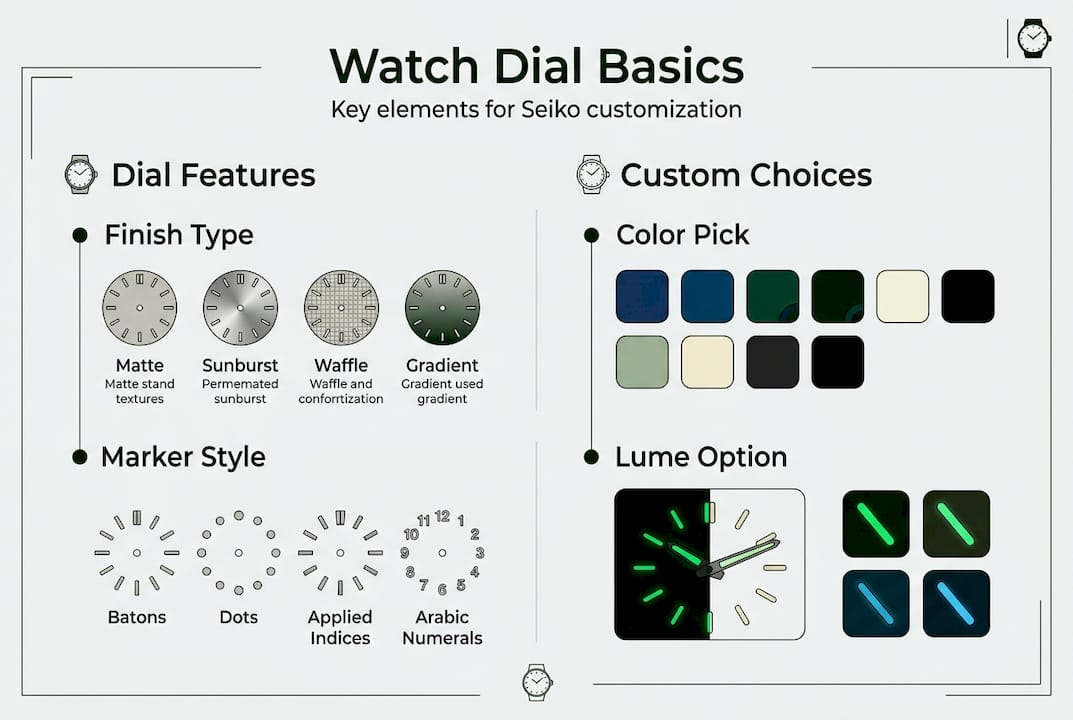
Printed versus applied markers represent a fundamental decision in Seiko mods. Printed markers keep the dial thin and allow intricate designs impossible with applied elements. They work well for vintage-inspired builds or minimalist aesthetics. Applied markers add dimension and luxury feel, catching light to improve legibility. They require precise installation to avoid misalignment that ruins the overall appearance.
Common mistakes when customizing Seiko dials:
- Ignoring dial feet compatibility with your specific movement model
- Choosing low-contrast color combinations that sacrifice legibility
- Selecting finishes inappropriate for intended wearing conditions
- Overlooking lume quality, resulting in poor nighttime visibility
- Mixing design elements from incompatible style categories
- Failing to verify dial diameter and hand clearance specifications
Dial choice profoundly impacts watch character. A vintage cream dial with aged lume creates nostalgic warmth. A stark white dial with black markers delivers clinical precision. Vibrant colors like turquoise or orange make bold statements. Your dial selection sets the tone for all other modification decisions, from case finish to strap choice.
Pro Tip: Source dial materials from reputable suppliers who provide detailed specifications and quality guarantees. Cheap dials often suffer from poor printing registration, uneven finishes, or incompatible dimensions that waste time and money during assembly.
Sourcing quality components requires research and sometimes trial and error. Established mod parts suppliers offer pre-vetted compatibility with common Seiko movements like NH35 or 4R36. Custom dial manufacturers can create unique designs but require minimum order quantities and longer lead times. Salvaged vintage dials provide authentic patina but may need restoration or carry unknown condition issues.
Expert craftsmanship becomes critical for complex customizations. Installing applied markers demands precision alignment and secure adhesion. Refinishing vintage dials risks destroying original character if done improperly. Lume application requires steady hands and proper curing to achieve even glow and longevity.
For those ready to take the next step, resources like how to mod a Seiko guide provide detailed instructions. Avoiding common Seiko dial mistakes saves frustration and produces better results. When your vision exceeds your technical skills, professional services through options like custom watch requests ensure expert execution.
Explore unique Seiko watch customizations at Ottoman Prieur
Ready to transform your Seiko watch vision into reality? Ottoman Prieur specializes in custom-built Seiko watches that showcase expert dial craftsmanship and quality materials. Whether you’re drawn to classic sunray finishes, bold color combinations, or intricate applied markers, their team brings technical expertise to every build.
Explore the Seiko mod store to discover curated builds demonstrating diverse dial styles and finishing techniques. Each piece reflects careful attention to detail, from marker alignment to lume application. For truly personalized expression, submit a custom watch request detailing your ideal dial specifications, finish preferences, and aesthetic goals. The craftsmanship team collaborates with you to source premium components and execute precise assembly. Check out distinctive examples like the Seiko Royal Oak Chronograph to see how dial customization elevates Seiko movements into unique timepieces that rival luxury brands.
Frequently asked questions about watch dials and Seiko customization
What materials are best for durable watch dials?
Brass base plates offer the best balance of workability, stability, and finish adhesion for long-term durability. Aluminum provides lighter weight but may dent more easily under impact. For maximum longevity, choose dials with quality lacquer or enamel protective coatings that resist scratching and oxidation over years of wear.
How does dial finishing affect watch readability?
Matte finishes eliminate glare for excellent readability in bright conditions, making them ideal for outdoor or tactical use. Glossy finishes provide high contrast in moderate lighting but can reflect light sources that obscure time reading. Sunray finishes offer a middle ground with dynamic light play that generally maintains good legibility across varied conditions.
What pitfalls should I avoid customizing a Seiko dial?
Verify dial feet positioning matches your movement model before purchasing, as incompatible mounting prevents installation. Ensure adequate hand clearance to avoid contact between hour hand and dial surface. Avoid low-contrast color schemes that look attractive in photos but prove difficult to read in real-world conditions. Always test lume quality, as poor luminous material fades quickly and defeats nighttime functionality.
How common are rare dial types like meteorite or enamel?
Genuine meteorite and grand feu enamel dials remain extremely rare in the watch industry, typically reserved for luxury timepieces costing thousands of dollars. Most affordable watches claiming these materials use simulated effects or lower-quality alternatives. True artisanal dials require specialized craftspeople and extensive production time, limiting availability even among high-end manufacturers.
Why customize a Seiko watch dial instead of buying factory?
Customization allows you to express personal style impossible with mass-produced factory options. You can combine finish types, colors, and marker styles unavailable in any single production model. Custom dials let you create watches that reflect your aesthetic vision while maintaining Seiko’s reliable movement quality. The watch modding community values this creative freedom and the unique pieces it produces.